
What your baby’s microbiome knows before you do, and why a mother’s gut may be the most important inheritance she passes on.
Catherine Stanton pulled up a heat map on her screen. It showed the bacterial genera present in an infant’s gut at week one, week four, and week 24. The colours at week one bore almost no resemblance to the colours at week 24. The species that dominated the newborn gut were gone by six months. The species that would go on to populate the adult microbiome were absent at birth and abundant half a year later.
Catherine is a principal investigator at APC Microbiome Ireland and Senior Principal Research Officer at Teagasc, Ireland’s Agriculture and Food Development Authority, as well as a Research Professor at University College Cork. Teagasc is not the obvious home for microbiome science until you learn that Ireland produces roughly 15 percent of the world’s infant formula, which makes infant nutrition a national industry as much as a research question. She has spent more than two decades studying the infant gut microbiome, the factors that shape it, the exposures that disrupt it, and the window of time in which those disruptions matter most.
Her work has taken her from the neonatal intensive care units at Cork University Maternity Hospital to a longitudinal study tracking 500 mother-baby pairs through the first five years of life. The data she showed me over two hours in a conference room at the BioSciences Institute amounted to a single, accumulating argument:
the first thousand days of a child’s life are a period of microbial programming so precise and so consequential that we cannot afford to ignore what goes right, what goes wrong, and what we might do about it.
The Mother’s Gut Comes First
A baby is born, by current scientific consensus, with no microbiome. A 2023 analysis published in Nature examined the evidence for in-utero microbial colonization and concluded that the fetal environment is sterile; earlier claims of a “placental microbiome” were attributable to contamination in low-biomass samples.¹ The colonization of the infant gut begins at birth and proceeds rapidly.
The most influential source of that colonization is not where most people assume. The vaginal microbiome has received enormous attention as a seeding source, and it does contribute detectable organisms to the newborn gut, particularly during vaginal delivery.
But most of those vaginal species are lost, or have fallen below detection, by the end of the first week.² The maternal gut microbiome is the enduring influence.
A 2018 study in Cell Host & Microbe that tracked 25 mother-infant pairs across multiple body sites, from birth to four months, found that the mother’s stool microbiome accounted for 22.1 percent of the microbial abundance in her infant’s gut, the largest contribution of any maternal body site and well ahead of the vagina at 16.3 percent.² Catherine’s own group, reviewing this literature, states the conclusion plainly: the maternal gut microbiota is the greatest maternal source of the strains an infant acquires immediately after birth.³ A 2025 study in Microbiology Spectrum went further: maternal gut microbiota at 32 weeks of pregnancy was the primary source of meconium microbiota, while vaginal microbiota contributed less than one percent.⁴
This distinction matters for how we think about intervention. If the vaginal microbiome were the primary driver, then vaginal seeding of C-section babies, a practice that has generated considerable interest, would address the core deficit. But if the maternal gut is the deeper source, then the intervention needs to be different, and the preparation needs to start earlier.
Colin Hill and Paul Cotter had already shown me what a diverse, fermented-food-rich diet does for an adult microbiome. Catherine’s work showed me what it does for the one you are about to create.
She was direct about the implication. A mother’s diet before and during pregnancy shapes the microbial community she will pass to her baby. We tell expecting mothers to take folic acid for their baby’s neural tube. We tell them to play classical music. We tell them to avoid soft cheese and sushi and deli meat. Nobody tells them that the fibre they eat today is feeding the bacterial community their baby will inherit next month.
Mediterranean diet, fermented foods, diverse plant fibres; these are investments in the baby’s microbiome that gets a fraction of the attention we give the prenatal vitamin bottle, though the science is younger and less settled.
What C-Section Takes Away
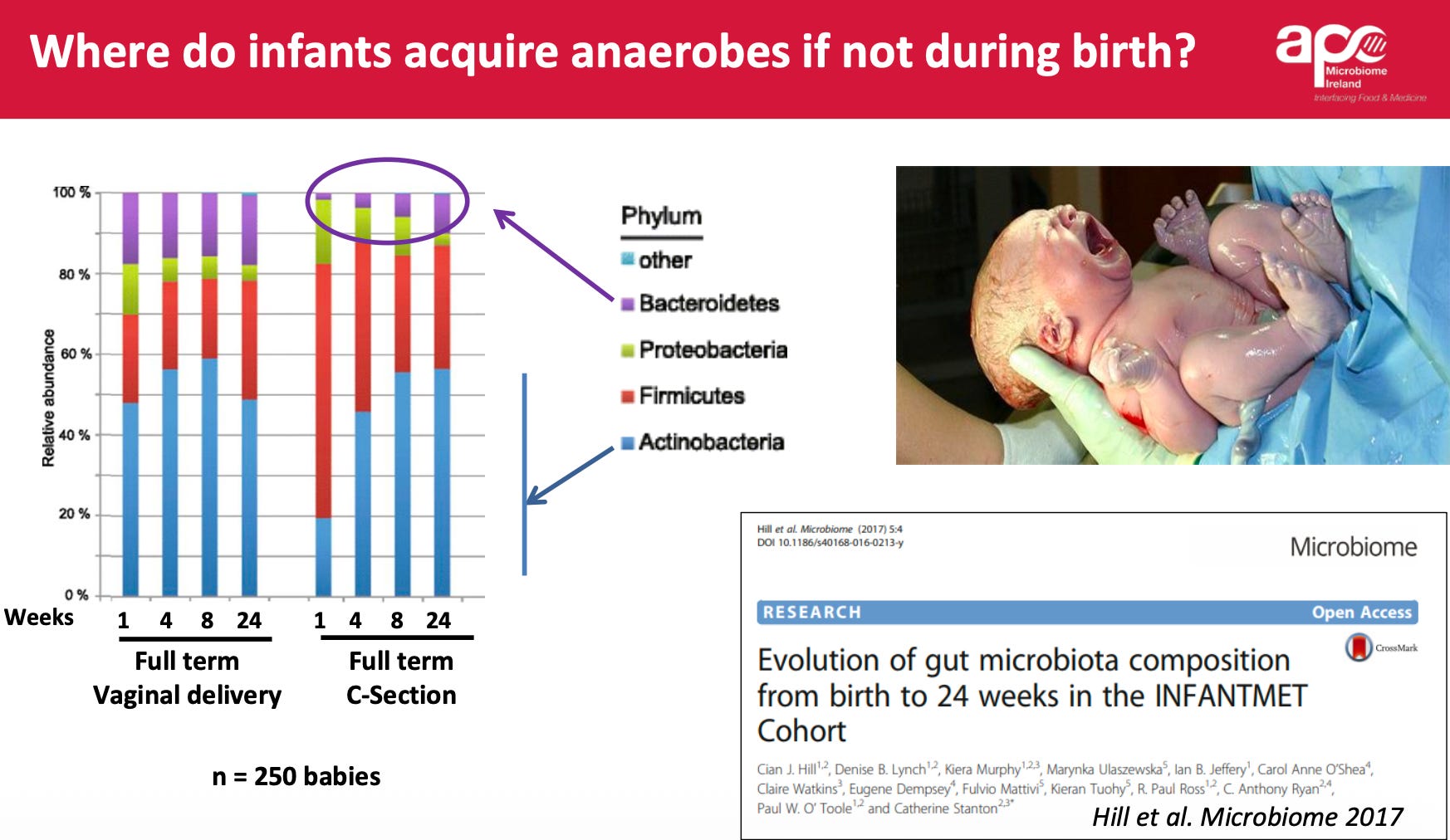
Catherine’s first major infant study, published from the Infantmet cohort, compared the gut microbiomes of three groups of babies across the first 24 weeks of life: full-term vaginally delivered, full-term C-section delivered, and preterm.⁵
The differences between vaginal and C-section babies were stark, especially in the first weeks of life. Vaginally delivered babies showed early enrichment in Actinobacteria, particularly Bifidobacterium, which made up roughly half their gut community by the end of the first week. C-section babies had markedly lower levels. Vaginally delivered babies also had higher levels of Bacteroidetes, organisms that are important residents of the adult human gut and play key roles in immune education. In the C-section group, these bacteria were nearly absent in the early weeks.
The differences were most dramatic at birth and in the first month. By six months, the profiles began to converge. But the early period, the window when the immune system is immature and rapidly developing, is precisely when the presence or absence of specific microbes may matter most.
Catherine called these the missing microbes of C-section. C-section babies are colonized, but by different organisms, often including higher levels of potentially pathogenic bacteria and organisms associated with the hospital environment rather than the maternal gut.
A 2019 study in Nature confirmed the pattern at scale: caesarean-born babies were enriched in opportunistic pathogens including Enterococcus, Enterobacter, and Klebsiella species, while vaginally born babies were colonized by commensal Bifidobacterium and Bacteroides from their mothers.⁶
The preterm infants showed an even more disrupted pattern. Their guts were enriched in Proteobacteria, a phylum that includes many potentially pathogenic species, and carried higher levels of antibiotic resistance genes, a consequence of the intensive medical interventions that keep them alive in those critical early weeks.
The Four-Year Imprint
One of the most striking findings from the Infantmet study emerged when Catherine followed the cohorts to four years of age. By that time, the gut microbiomes of full-term babies had matured considerably; diversity had increased, adult-associated species had become established, and the early dominance of Bifidobacterium had given way to a more complex community.
But the preterm infants, even at four years of age, still showed a statistically significant separation from their full-term peers. Catherine’s team published the finding in Nature Communications in 2019.⁷ Their microbiomes had not fully caught up. The early disruption, the consequence of premature birth and the medical interventions it requires, had left a detectable imprint four years later.
“The microbiome seems to have some sort of a memory of premature birth.”
A memory. We think of the microbiome as dynamic, responsive, changeable. And it is. But it is also, in some way, a ledger. The conditions of your earliest days leave marks that persist long after the original disruption has passed. The programming that happens in the first thousand days is not easily overwritten.
The Mother’s Investment
Catherine showed me a graph of Bifidobacterium abundance across the human lifespan. In infancy, these organisms dominate the gut. As people age into adulthood, their relative abundance declines. By old age, they are a small fraction of the community. APC researcher Paul O’Toole’s work on the elderly microbiome has shown that maintaining Bifidobacterium levels is associated with healthier aging, and their depletion is a feature of frailty.
But the early dominance of Bifidobacterium in infants has a specific driver: human milk.
Human breast milk contains large quantities of human milk oligosaccharides, or HMOs, complex sugars that the baby’s own digestive enzymes cannot break down. The baby cannot use them. They pass through the stomach and small intestine intact and arrive in the colon, where the infant’s Bifidobacterium and other gut microbes possess exactly the enzymatic machinery needed to ferment them.
HMOs are the third most abundant solid component of breast milk after lactose and fat, present at concentrations of 10 to 15 grams per litre, at concentrations approaching or exceeding that of protein in early lactation. The mother’s body expends enormous metabolic energy to produce compounds that serve no direct nutritional purpose for the baby. They are food for the baby’s microbiome.
Colin Hill, when I spoke with him earlier that week said, “if a germ-free baby were given breast milk, every one of those HMOs would come out the other end untouched. They exist primarily for the microbiome, though they also play direct roles in immune modulation and pathogen defence. The mother is not just feeding her baby. She is saying, through billions of years of evolutionary logic: I need to get your microbiome a good start.”
The implications for infant feeding are significant.
The Infantmet study showed that breastfeeding drove microbiome development more strongly in C-section babies than in vaginally delivered babies.
The naturally born infants already had a head start from the seeding they received during birth. The C-section babies, starting from a more immature microbial community, depended more heavily on breast milk to compensate.
A local Cork newspaper distilled the finding into a headline: breast milk is crucial to C-section born babies. Catherine confirmed the thrust of it. The more immature the infant’s microbiome at birth, the more important breastfeeding becomes as a corrective force.
The Milk Changes Too
Catherine’s lab has also studied the milk microbiome itself across lactation. Human milk is not a static fluid. Its composition shifts over the first six months and beyond, with changes in immune components, antibodies, and microbial communities.
The bacteria present in colostrum, the concentrated first milk, differ from those in mature milk at six months. The milk microbiome composition separates by stage of lactation, with different organisms playing larger or smaller roles as the infant grows.
Like the infant gut itself, the microbial component of milk is not one thing. It is a sequence, choreographed across time.
This raises practical questions about donor milk, which is pasteurized and pooled before being given to premature infants who cannot receive their own mother’s milk. When I was leading a health authority serving two million people, we introduced a donor milk program for our communities. I remember the excitement in the room when the clinical team presented the evidence, the sense that we were offering something both ancient and urgent to the smallest, most vulnerable patients in our system. We were among the first health authorities in the region to do it. At the time, I understood donor milk as nutrition. Catherine’s research reframes it as something more: a microbial transfer, a biological choreography, and one that processing can disrupt.
Her team has been investigating alternative methods, including high-pressure processing, that might eliminate dangerous pathogens while preserving more of the biologically active components that heat destroys. A 2022 study in Clinical Nutrition showed that high hydrostatic pressure processing preserved milk oligosaccharides while standard Holder pasteurization increased Maillard reaction products.⁸ The principle is straightforward: if the microbial and bioactive components of milk are part of its value, then processing methods that destroy them are reducing what the milk can do.
The Case for Giving Exactly Enough
A separate line of Catherine’s research examined the consequences of early antibiotic exposure. In a 2024 study published in Microbiome, babies who received benzylpenicillin and gentamicin in the first days of life showed a persistent amplification of antibiotic resistance genes in their gut microbiomes tracked across five time points from birth to two years.⁹ The resistance was not limited to the antibiotics the babies had actually received. It extended to other drug classes entirely, because the antibiotic exposure selected for bacteria, mainly Proteobacteria, carrying broad multiple-drug-resistance profiles. Delivery mode shaped the newborn gut more than anything else in the first week of life, but its imprint faded with time, while the mark left by those first days of antibiotics persisted across the two years the babies were followed.
Paul Ross, in our earlier conversation, had described the same finding from a different angle. His team looked at babies treated with two antibiotics in the first four days of life and tested for resistance six months to a year later. They found not just resistance to those two drugs, but multiple drug resistance across classes, because the antibiotics selected for organisms with a lineage of exposures accumulated long before the baby was born.
In a premature or septic newborn, benzylpenicillin and gentamicin are lifesaving, and because neonatal sepsis can kill before a blood culture comes back, treating on suspicion is the right call. The research leaves that untouched. What it adds is a case for precision: giving these drugs to the babies who need them, at the narrowest spectrum that works, and stopping the moment cultures rule infection out. Most newborns started on antibiotics for suspected sepsis turn out not to be infected, and it is the unnecessary extra days of exposure, not the treatment of a genuinely sick infant, that the resistome data give us reason to trim.
Some of the repair is already underway. When the neonatal team at Cork University Maternity Hospital introduced routine probiotic supplementation for very preterm infants, they tracked the outcomes before and after the change and found that the combined rate of death and severe necrotizing enterocolitis, a catastrophic gut injury of prematurity, had fallen.¹⁰ The cohort was small and the study observational, but for the most fragile patients in the building, a signal like that is enough to keep the practice going.
Giving Back What Was Taken
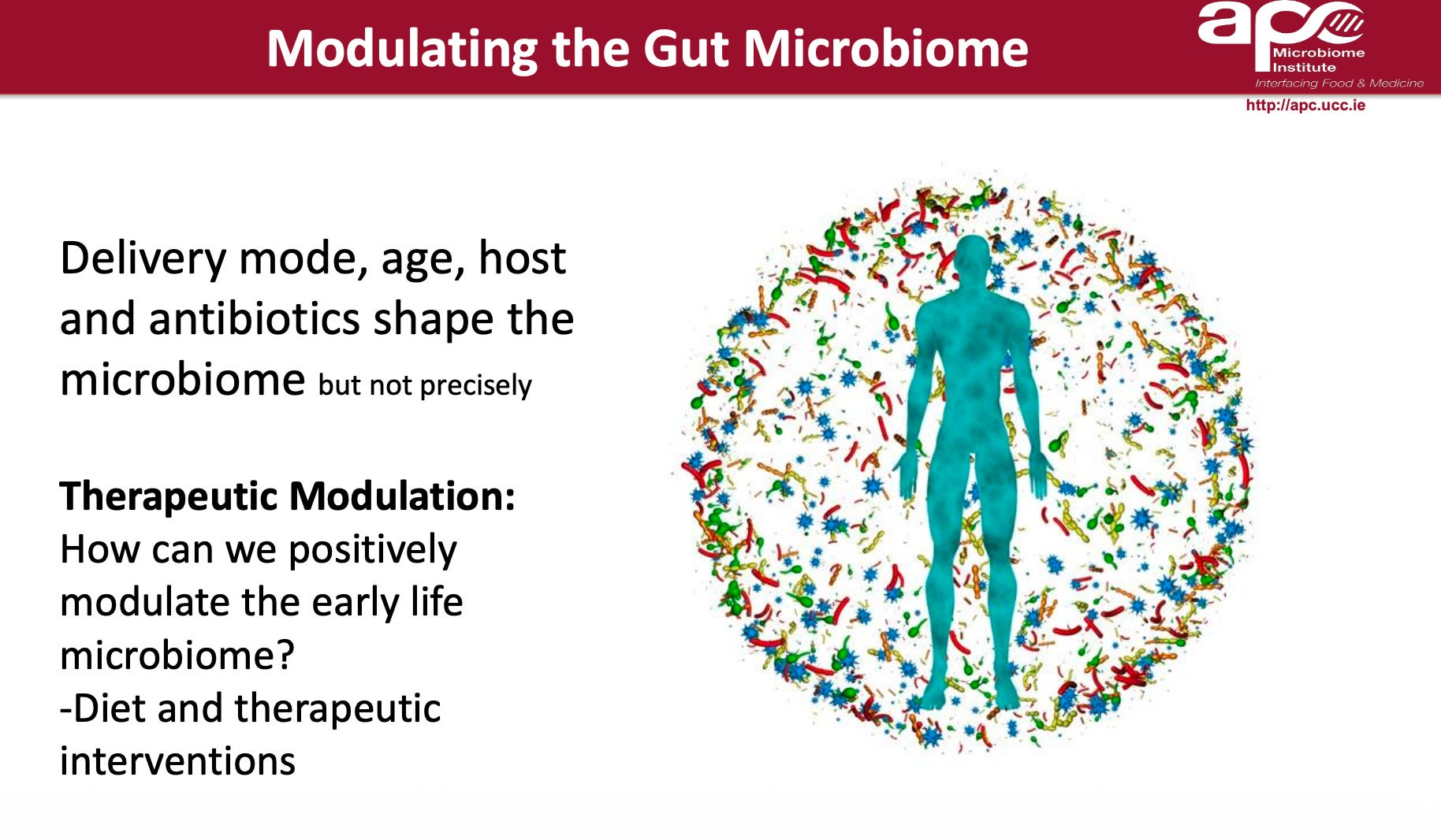
Catherine’s current study, called MIMIC, is the largest and most ambitious of her career. Five hundred mother-baby pairs across four groups: two groups of vaginally delivered babies (one with and one without antibiotic exposure during the third trimester) and two groups of C-section babies (similarly divided by antibiotic exposure). The study uses shotgun metagenomic sequencing, a far more detailed method than the 16S sequencing used in earlier work, to characterize the functional capacity of the microbiome, not just which organisms are present but what they are doing.
But the piece of the MIMIC study that excited Catherine most was the translational one. Her team has isolated the specific bacteria that are present in vaginally delivered, non-antibiotic-exposed infants at key time points and absent in C-section babies. They have characterized those organisms, confirmed their safety, verified the absence of antibiotic resistance genes, and assembled them into a consortium.
The vision is a precisely timed intervention. Not a generic probiotic, but a defined community of organisms that a C-section baby should have received from its mother’s gut during vaginal delivery, given at the right developmental stage, to restore what the mode of birth took away.
It is not a pill. It is a biological inheritance, reconstructed.
What an Expecting Mother Can Do Now
I asked Catherine the question I suspected many readers would ask. Given everything the research shows about maternal gut microbiome transfer, about the importance of those first microbial exposures, about the role of breast milk in driving microbiome development; what should a woman who is pregnant or planning to become pregnant actually do?
Her answer was grounded and free of hype. A healthy, diverse diet, rich in fibre, fruits, vegetables, and fermented foods. The Mediterranean dietary pattern, she said, is among the best-supported for gut microbiome diversity.
The better the quality of the mother’s own gut microbiome, the better the microbial foundation she can pass to her infant.
This is not different from the advice to take folic acid before and during pregnancy. It is an investment in a specific biological outcome; one that happens to be invisible to the naked eye but no less real for being so.
She was candid about what is not yet taught. “In medical school, nobody talks about the maternal gut microbiome as a factor in infant health. Nobody counsels pregnant women to think about their diet in terms of the microbial community they will transfer to their baby. The conversation about folic acid is universal. The conversation about fibre, fermented foods, and microbial diversity has not yet begun.”
Catherine thinks it should.
Paul Ross made the same point from a systems perspective. We have had practices that affect the microbiome at a very early age, he said. C-sections, early antibiotics, formula feeding. And those practices can have consequences. But the more we learn about it, the more we learn how to compensate. Babies will continue to be born by C-section. Babies will continue to get lifesaving antibiotics. But it does not have to totally denude the microbiome. We can replace some of those bacteria back.
The first thousand days are a window. It is closing faster than most parents realize. And the tools to keep it open, from maternal diet to breastfeeding to precisely designed microbial consortia, are either already available or approaching the clinic.
“Mind your microbes”, Catherine said as I gathered my things. Then she smiled. “That is what we say around here”.
Soul Inquiry
We now know a mother’s diet, microbiome, and birth choices help lay the microbial foundation for her child’s entire life. If you could go back and give your mother (or yourself, if pregnant/planning) one piece of advice about nurturing that invisible inheritance, what would it be?
This is the fifth of six posts from my visit to APC Microbiome Ireland in Cork. Catherine’s research traces the microbial inheritance a mother gives her baby. But the mother’s own microbiome does not stop changing once the baby arrives. Next: what your gut is quietly doing during perimenopause, and the neuroscientist who found the connection by accident.
Many thanks to everyone at APC who so generously gave their time during my visit. The science is theirs, and I am grateful for the opportunity to share it.
References
¹. Kennedy, K. M., de Goffau, M. C., Perez-Muñoz, M. E., et al. (2023). Questioning the fetal microbiome illustrates pitfalls of low-biomass microbial studies. Nature, 613, 639-649. https://doi.org/10.1038/s41586-022-05546-8
². Ferretti, P., Pasolli, E., Tett, A., et al. (2018). Mother-to-infant microbial transmission from different body sites shapes the developing infant gut microbiome. Cell Host & Microbe, 24(1), 133-145.e5. https://doi.org/10.1016/j.chom.2018.06.005
³. Linehan, K., Dempsey, E. M., Ryan, C. A., Ross, R. P., & Stanton, C. (2022). First encounters of the microbial kind: Perinatal factors direct infant gut microbiome establishment. Microbiome Research Reports, 1(2), 10. https://doi.org/10.20517/mrr.2021.09
⁴. Xie, H., Meng, L., Duan, X., et al. (2025). Establishment of the early gut microbiota in vaginally delivered infants: the influence of maternal gut microbiota outweighs vaginal microbiota. Microbiology Spectrum, 13(9), e0177525. https://doi.org/10.1128/spectrum.01775-25
⁵. Hill, C. J., Lynch, D. B., Murphy, K., et al. (2017). Evolution of gut microbiota composition from birth to 24 weeks in the INFANTMET cohort. Microbiome, 5, 4. https://doi.org/10.1186/s40168-016-0213-y
⁶. Shao, Y., Forster, S. C., Tsaliki, E., et al. (2019). Stunted microbiota and opportunistic pathogen colonisation in caesarean-section birth. Nature, 574, 117-121. https://doi.org/10.1038/s41586-019-1560-1
⁷. Fouhy, F., Watkins, C., Hill, C. J., et al. (2019). Perinatal factors affect the gut microbiota up to four years after birth. Nature Communications, 10, 1517. https://doi.org/10.1038/s41467-019-09252-4
⁸. Marousez, L., et al. (2022). High hydrostatic pressure processing of human milk preserves milk oligosaccharides and avoids formation of Maillard reaction products. Clinical Nutrition, 41(1), 1-8. https://doi.org/10.1016/j.clnu.2021.11.013
⁹. Patangia, D. V., Grimaud, G., O’Shea, C. A., Ryan, C. A., Dempsey, E., Stanton, C., & Ross, R. P. (2024). Early life exposure of infants to benzylpenicillin and gentamicin is associated with a persistent amplification of the gut resistome. Microbiome, 12, 19. https://doi.org/10.1186/s40168-023-01732-6
¹⁰. Healy, D. B., et al. (2023). Neonatal outcomes following introduction of routine probiotic supplementation to very preterm infants. Acta Paediatrica, 112(10), 2093-2101. https://doi.org/10.1111/apa.16923