The Encounter
From Seoul to Soul

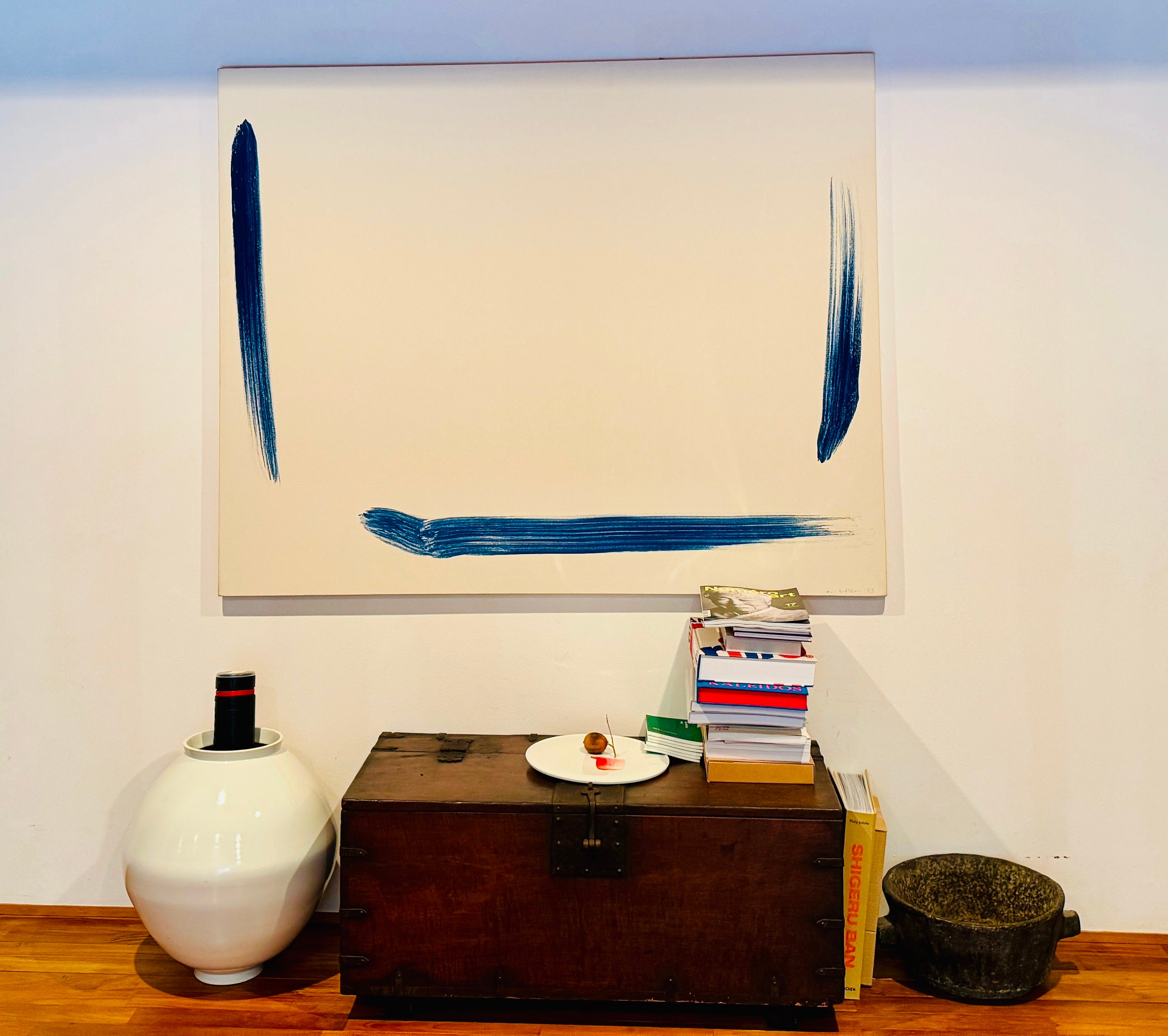
“My art is not a representation of me. It is born from relationships between ‘I’ and ‘other.’”
Lee Ufan
My father could not reach his cousin. He had been trying for years, dialling the international number from Toronto and getting nothing. He tried at different hours. He tried on different days. He assumed the number had changed, or that his cousin was travelling.
Then, just days before our family trip to Japan, it dawned on my father that he had been pressing 001 instead of 011 in front of the country code. He changed the number, dialled again, and the line connected. His cousin answered. They had not spoken in years. His cousin was going to be in and out of New York and Japan over the coming weeks, but for the exact dates we would be travelling, he would be there.
Everything was coming together. The reason for going to Japan had been to see him again. My parents are getting older. We did not know if another opportunity would come. We had been prepared to start cold-calling once we arrived, showing up and hoping. This was much better.
In Kamakura
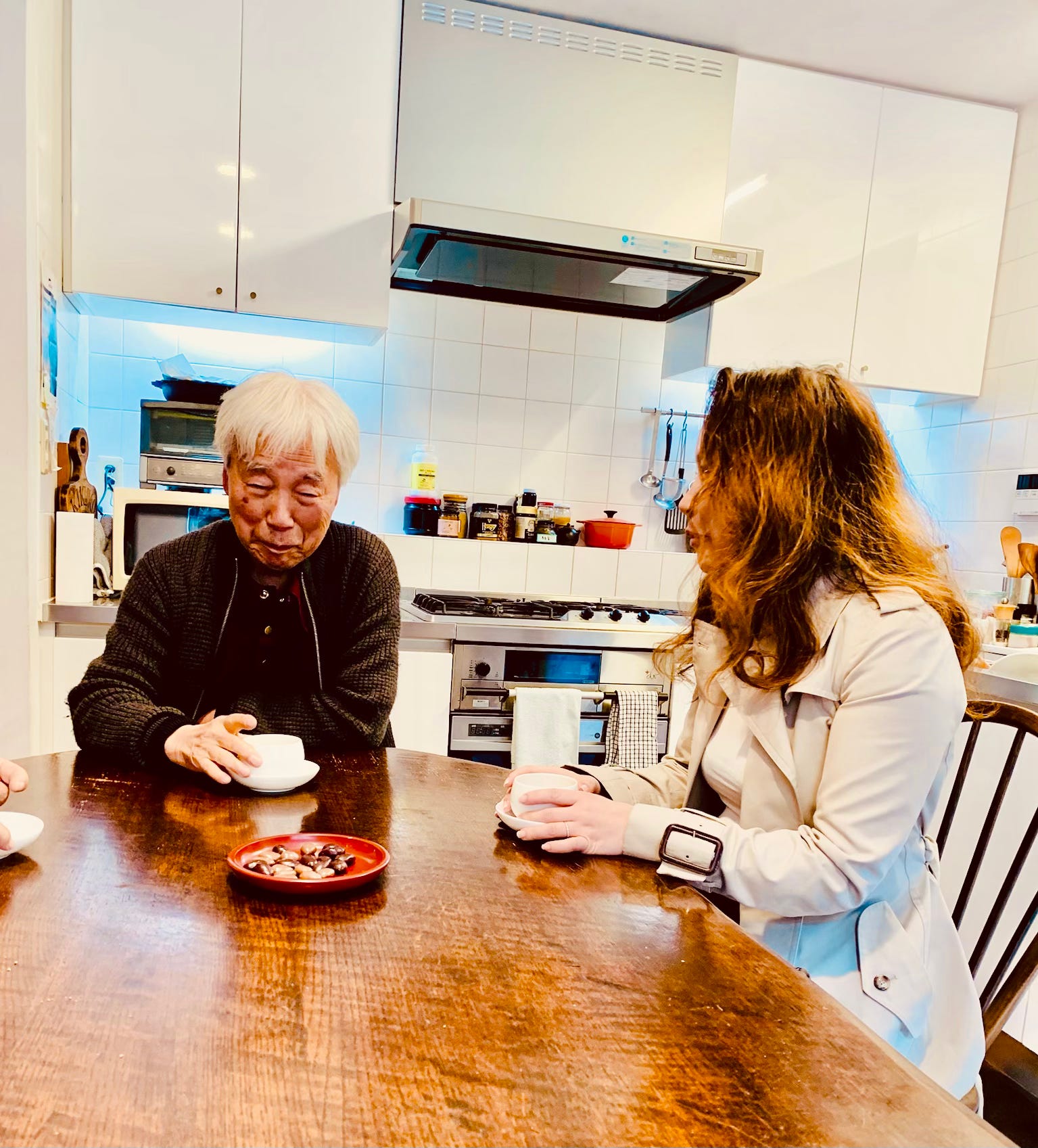
We sat together in Kamakura, the coastal city south of Tokyo where Zen temples line the valleys and the Great Buddha sits open to the sky. The conversation moved the way conversations do when two people have not seen each other in years and know the window may not open again: quickly, across everything, with the urgency of people who have more to say than time allows.
I had known my father’s cousin my whole life, though for most of it I knew him the way children know family legends: through objects and stories rather than the person himself. His art hung in my grandparents’ house. Small pieces, nothing from the major collections, but present the way family photographs are present, as evidence that this person belongs to us. My grandmother spoke of him with particular tenderness. He had stayed with them in Korea when he was young, and she had been kind to him during a time when kindness was scarce. That bond between them never loosened, even as his life carried him further from the household where it began.
In adulthood I came to know him differently. I stayed with him and his wife when I visited Japan during medical school. My father had done the same years earlier, when he was in Japan researching mountaineering equipment. At his home and studio, the small pieces I had grown up with made sense inside a larger body of work: canvases the size of a hand beside paintings that reached the ceiling, sculptures in the garden, and brush sets ranging from the tiniest I had ever seen to the largest. And I discovered his writing, which touched me deeply. The philosophical essays on encounter and relation, on what it means to place one thing next to another and let the space between them speak, carried a precision and a quiet power that changed how I understood not just his art but the way I wanted to think about health, about systems, about the spaces between disciplines that most institutions leave empty.
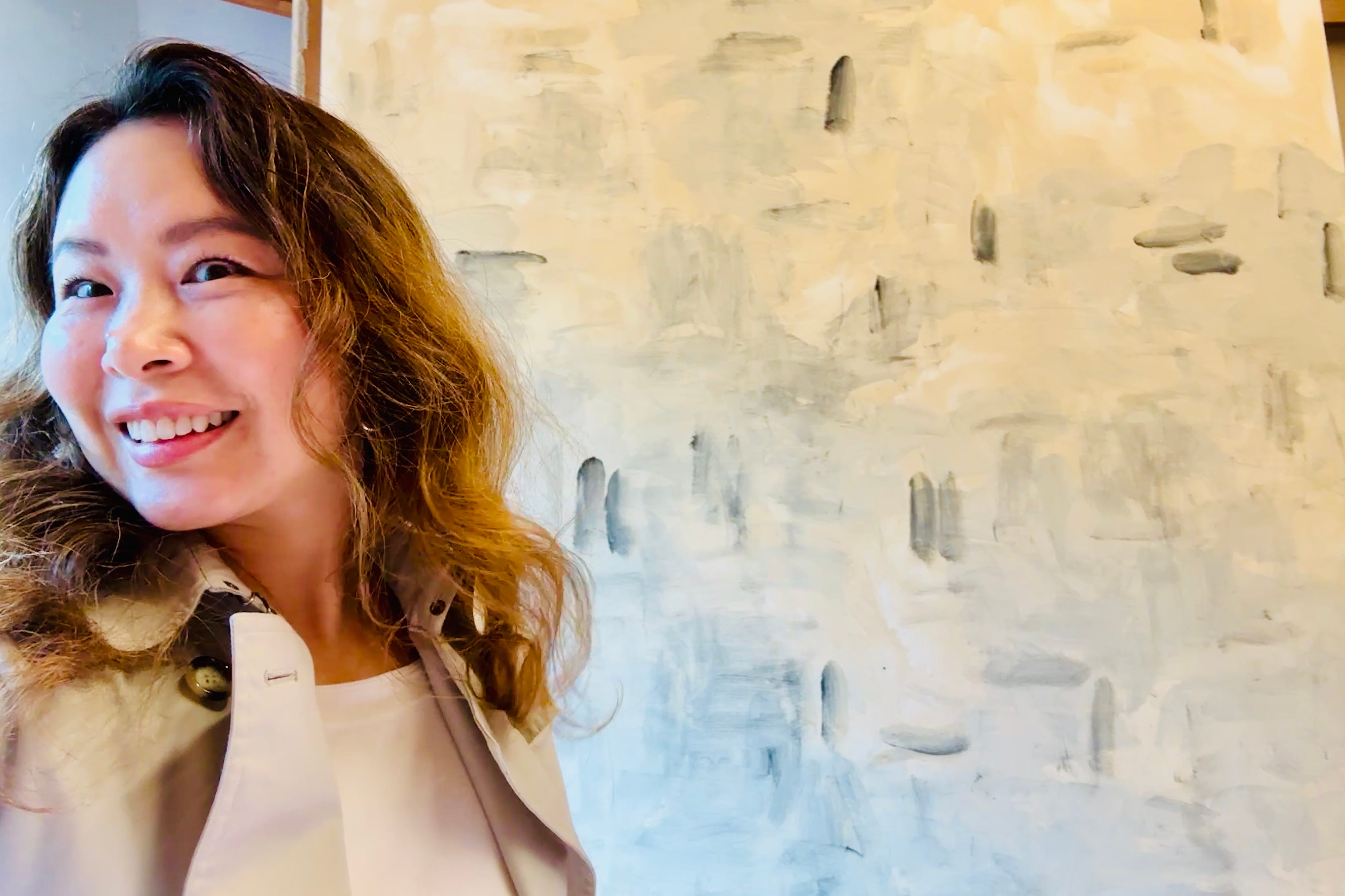
Sitting in Kamakura, I watched two men reconnect across decades, and the conversation gave shape to a life I had only known in pieces. He talked about leaving Korea. The crossing by ship, the difficulty of it for a young Korean man in the years after the war. The details came in fragments, the way family stories do when they have been carried for decades: something about cargo ships, the risk of being caught, the uncertainty of whether the crossing would be allowed at all.
He was born in 1936 in Haman, South Gyeongsang Province, into a traditional Confucian household where he received early training in poetry, calligraphy, and painting. His father sent him to Japan to deliver medicine to an ill uncle. The uncle urged him to stay and study. He enrolled at Nihon University in Tokyo, graduating in 1961 with a degree in philosophy, with a particular focus on Martin Heidegger. He was, at his core, a philosopher.
In his early years in Japan, before he had fully absorbed the language, the nuances of philosophical prose presented barriers that visual art did not. He turned to painting and sculpture, and what began as a practical response became something larger. He would go on to write extensively in Japanese, producing the theoretical essays that defined Mono-ha and earned him recognition as one of the movement’s essential voices. But by then the visual work had become its own language, and he never set it down.
He described the experience of being zainichi Korean, a Korean resident in Japan, simultaneously excluded from both Korean and Japanese art histories and sharpened by the perspective that exclusion creates. He talked about Germany becoming the place where the international art world first paid serious attention. The European reception gave him the institutional platform that Japan and Korea had been slower to provide, partly because his cross-cultural position made him difficult to categorize.
The institutions caught up. Lee Ufan’s work sits in the collections of MoMA, the Guggenheim, the Centre Pompidou, and the Tate. He has had major exhibitions at the Guggenheim in New York, the Palace of Versailles, and the Hamburger Bahnhof in Berlin. A museum designed by Tadao Ando on the island of Naoshima in Japan’s Inland Sea is dedicated entirely to his work. He became the leading theorist of Mono-ha, the late-1960s Tokyo movement that placed raw materials, stone, soil, steel, glass, in relation without transforming them. His sculptural series Relatum, begun in 1968, defines each work not as an object but as an encounter: the relationship between material, space, and the person standing in front of it. His paintings from the From Point and From Line series place a single brushstroke or dot on vast empty canvas, insisting that what is not there is as important as what is
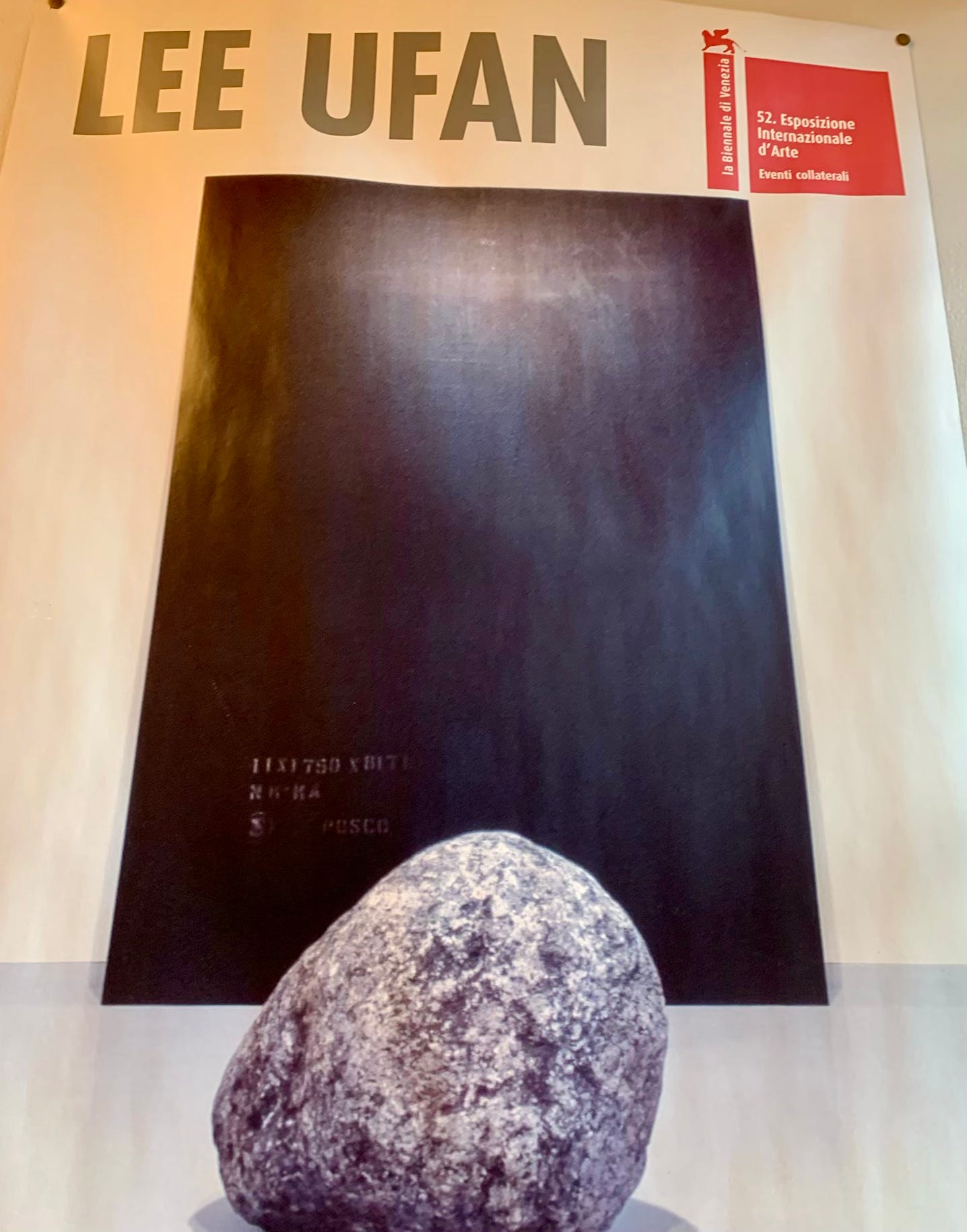
.
And he talked about what his art is actually about. Not the object and not its representation but the encounter, the relationship between what is made and what is not made, between the mark on the canvas and the space surrounding it. He used the Japanese concept of yohaku, the negative space in East Asian painting that Western traditions tend to fill. In a conversation with the curator Michael Brand at the Art Gallery of New South Wales, he described a related idea, ma:
“Ma, the void or emptiness, is very meaningful, between the creating and not creating; I thought we could think slowly and that would free us.”
Then the conversation turned somewhere I had not expected from a man whose career spans nearly seventy years of physical materials. Artificial intelligence. He had been teaching, and what troubled him was not the technology itself but what it revealed about his students. Art, he said, lives in the space where there is no correct answer, only the encounter between the viewer and the work. When he asked a classroom, “What do you think?”, they reached for their laptops. They searched for someone else’s interpretation instead of forming their own. So he changed the question.
“What do you feel?” he pressed. “Not what somebody else is telling you.”
It landed differently hearing it from a man who has spent his life insisting that the encounter is the art. Emerging research suggests that habitual use of AI for cognitive tasks reduces people’s willingness to think independently.¹ But thinking is only the first casualty. The encounter Lee Ufan builds his art around is not intellectual. It is felt. His work does not tell you what to feel. It places materials in relation and waits. The stone does not explain itself. The empty canvas does not fill itself in. You bring the meaning, or you do not. There is no LLM for the experience of standing in front of a rock and a curved steel plate in a quiet gallery, letting the silence between the stone and the steel do its work.
Months after that conversation, a story appeared in my feed that proved his point with surgical precision. An artist had posted one of Claude Monet’s Water Lilies, painted circa 1915 and held in the Neue Pinakothek in Munich, to social media with an “AI-generated” label. Hundreds of people, including self-described art critics, produced confident, detailed critiques of what they believed was synthetic output. “This has no soul,” one wrote. Another published an 850-word breakdown of the supposed shortcomings. Consumer AI-detection tools flagged the painting with high probability scores. All of them were wrong. The label had done the work, not the image. The same qualities art history treats as hallmarks of Monet’s late style, unstable edges, strange colour, surfaces that resist easy reading, became “evidence of synthetic weakness” once the frame shifted. Research on aesthetic perception confirms the pattern. People systematically downgrade their assessments of art when told it is AI-generated, regardless of actual origin.² Lee Ufan’s questions, what do you think and what do you feel, had never been more urgent.
He is nearly ninety. He looked decades younger. Not in the way of people who have been preserved, but in the way of people who are still engaged. Sharp, vibrant, animated, physically present in his body in a manner that had nothing to do with cosmetic maintenance and everything to do with combustion. When he talked about his work, the energy was unmistakable. He described his relationship to art as something close to obsession, deeper than a career or a discipline, a compulsion that has never loosened its grip in decades of practice. He did not say this with resignation. He said it with the low, steady force of a man who has found the thing that fuels him and has no intention of setting it down.
The Japanese have a word for this: ikigai. A reason for being so essential that it structures your days and sustains your will to live. A prospective study of 43,391 Japanese adults in the Ohsaki cohort found that those who reported having ikigai had significantly lower mortality from cardiovascular disease and external causes over a seven-year follow-up.³ The effect was independent of age, exercise, BMI, smoking, and self-rated health. Purpose, measured as a single question about whether life felt worth living, predicted who would still be alive seven years later. Lee Ufan, still making, still travelling between Kamakura and Paris and New York, still placing stones against steel and watching what happens in the space between, is ikigai made visible.
I listened to my father and his cousin speak, and I noticed something I had not expected. The conversation itself was doing something, and it was not only emotional but physiological. The quality of attention in the room shifted. The pace of speech slowed. The space between sentences lengthened. Two men reconnecting across decades, talking about art and life and the crossing between cultures, and the room itself seemed to quiet around them.
What Happens in the Brain
What I felt in that room, the shift in attention, the deepening of presence, the sense that something was being processed at a level below conscious awareness, has a neurobiological signature.
When people view art they find deeply moving, the anterior medial prefrontal cortex, a core region of the default mode network, shows sustained activation rather than the typical suppression seen during external task engagement.⁴
This is the same network that activates during self-referential thinking, autobiographical memory, and theory of mind. Profound aesthetic experiences represent a distinct neurobiological state where the brain simultaneously engages internal reflection and external perception. The seesaw between inner and outer that characterizes ordinary consciousness is, briefly, suspended.
Aesthetic experience also activates the brain’s reward system: the ventral striatum, orbitofrontal cortex, and nucleus accumbens, regions enriched with dopamine receptors.⁵ The pleasure from encountering beauty operates through the same circuitry that processes food, music, and social bonding. The activation scales linearly with the observer’s aesthetic rating; the more moving the artwork, the stronger the dopaminergic response.⁴ ⁵
And when viewers encounter artwork depicting pain or suffering, they recruit the same somatosensory and empathetic brain regions that activate when experiencing pain themselves.⁶ Art does not merely represent emotion. It generates it, in the body, through shared neural circuitry.
A 2025 fMRI study found that evaluating visually ambiguous images activates the left medial prefrontal cortex more strongly than evaluating unambiguous ones.⁷ The challenge of resolving ambiguity, of sitting with uncertainty and letting meaning emerge rather than demanding it, produces its own form of rewarding engagement. Lee Ufan’s entire body of work is built on this. His art does not resolve. It asks you to stay in the space of not-knowing, and the brain, it turns out, finds that space rewarding
.
The Museum as Medicine
The neuroscience explains the mechanism. The epidemiology shows it working at scale.
A 2025 systematic review synthesizing 38 studies with 6,805 participants found that art viewing produces measurable improvements in wellbeing, particularly through what researchers call eudemonic wellbeing, the sense of meaning, purpose, and personal development.⁸ Not hedonic pleasure, which is transient, but the deeper sense that your life has shape and direction.
Art, it appears, is better at generating meaning than at generating happiness, and the distinction matters because meaning is more durable.
A randomized controlled trial at the Montreal Museum of Fine Arts tracked older adults through three months of museum art activities.⁹ In the group that went, full-day heart rate fell by about eight percent, to roughly 70 beats per minute against 74 in the controls, alongside gains in frailty and quality of life. A different medium from the onsen. The same direction: the body reads beauty and lets go.
When I led a health authority serving over two million people, we ran art therapy programs across multiple hospital sites. I watched patients in acute psychiatric and geriatric care pick up a brush and produce forty minutes of focused, calm attention that no medication in their chart had achieved. A 2024 meta-analysis of 50 studies found that active art therapy improved outcomes across depression, anxiety, self-esteem, and quality of life, with modest but consistent effect sizes of 0.19 to 0.38, meaningful given the near-absence of side effects.¹⁰ For anxiety in children and adolescents specifically, art therapy produced a large effect, a standardized mean difference of 1.42, comparable to some pharmacological interventions.¹¹
The response to art is personal, shaped by who you are and what you bring to the encounter.¹² The same principle Miyazaki found in forest bathing: the prescription is personal.
The Art of Not Making
Calligraphy, in the Chinese and Japanese traditions alike, integrates aesthetic creation with meditative practice. A 2024 study of older adults in China found that calligraphy practice significantly correlated with peace of mind, which in turn predicted perceived health status.¹³ A separate study in Japan found significant associations between regular calligraphy and lower odds of insomnia, particularly for sleep onset and early morning awakening.¹⁴ Sustained attention, present-moment awareness, breath coordination, the surrender of outcome to process. The brush does what sitting meditation does, and gives you something to look at when it is done.
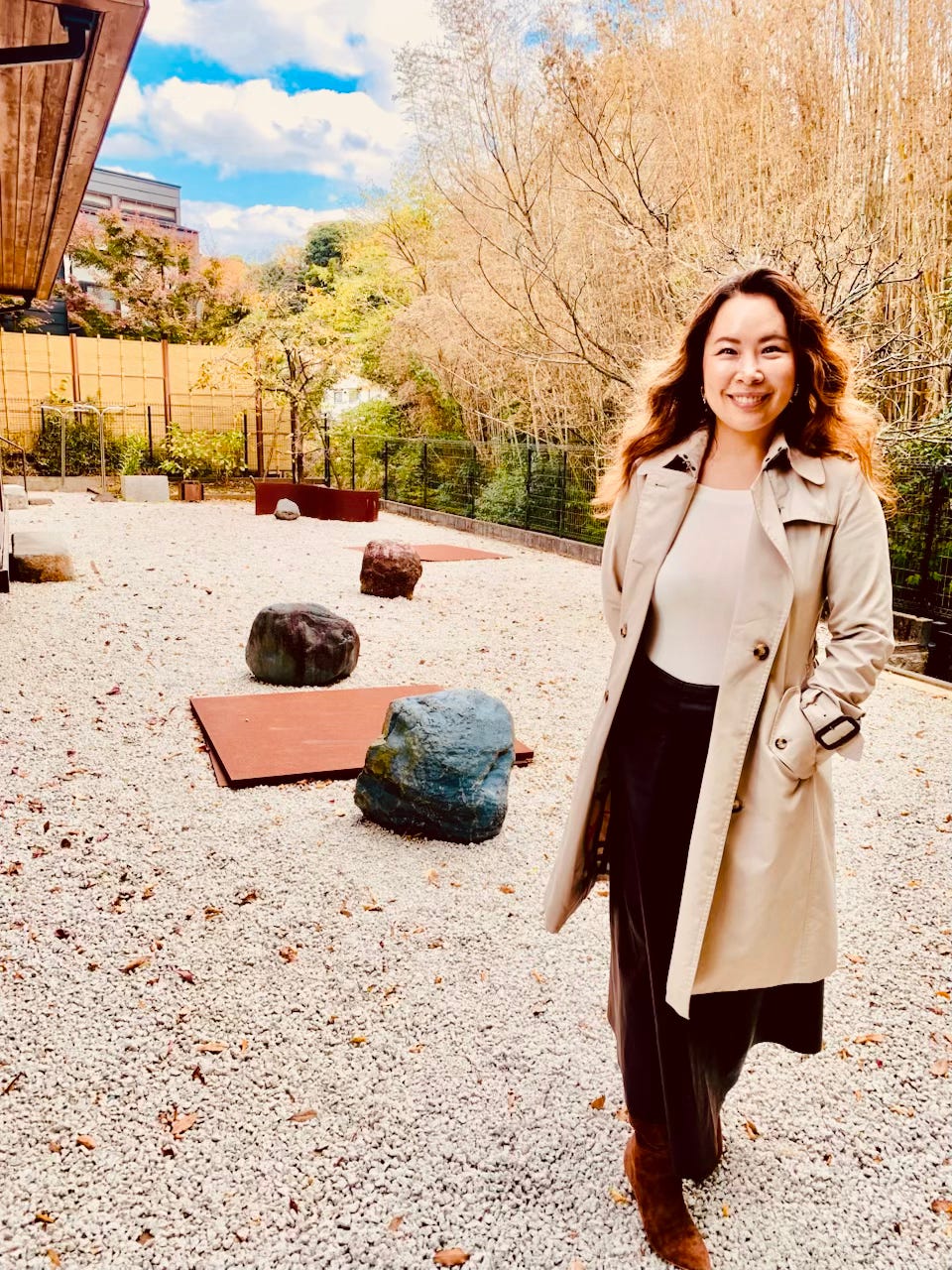
What connects calligraphy, tea ceremony, ikebana, and the Zen rock garden to Lee Ufan’s work is the principle of restraint. Japanese art traditions do not accumulate. They subtract. The single mark on the scroll. The raked gravel left mostly empty. The unmarked canvas surrounding Lee Ufan’s solitary mark. In a statement for the Mori Art Museum’s STARS exhibition, he put it plainly: “I have criticized the modern almighty, while committing myself to introducing into artistic expression the act of not making, not drawing, or the other and the external.”
The act of not making. In a medical system that measures health by what it adds, adding medication, adding procedures, adding interventions, the Japanese art tradition offers a different logic.
Sometimes health is found in what you stop doing. In the space you leave open. In the encounter with what is already there.
My Reflections
At a birthday gathering a few months later, I found myself with an artist and an Indigenous leader, one of those evenings where the conversation crosses every boundary anyone brought to it. We talked about the essence of life being able to see beauty in everything.
I had felt this since I was a girl. Crouching over a single leaf in the garden, tracing its veins, struck by how intricate and beautiful things are. A crack in a stone. The pattern of frost on a window. Beauty that existed without an audience. Noticing it felt like a quiet agreement between me and something larger.
I did not know, then, that this attention had a lineage. The man I had watched in Kamakura had built a lifetime of work out of exactly this, the insistence that what is barely there deserves your whole attention. He and I came from the same root. The reconnection was not just between two elderly men. It was between two branches of a family shaped by the same crossing from Korea, one carried to Japan, the other to Canada. A shared history of displacement and adaptation, the uncertainty of belonging fully to neither, and a refusal to choose one tradition over the other. I recognized my grandparents’ kitchen in it. My father carries both traditions. I carry them one generation further, in a body that has spent a medical career in Canada and now writes about wellspan from the intersections of cultures that most health systems treat as separate worlds. The insistence, passed down through kitchens and studios alike, that the space between two cultures is not empty but full.
My father dialled the wrong number for years. Then he changed one digit and the line connected. The relationship between what we do and what we fail to do. The encounter between effort and the thing that was waiting for the effort to arrive. Lee Ufan would understand this. It is, in its way, a Relatum.
Soul Inquiry
When was the last time a piece of art, a song, a written line, stopped you in a way that felt physical? What was your body trying to tell you?
Please share your thoughts and comments below
References
¹ Gerlich, M. (2025). AI tools in society: Impacts on cognitive offloading and the future of critical thinking. Societies, 15(1), 6. https://doi.org/10.3390/soc15010006
² Bellaiche, L., Shahi, R., Turpin, M. H., et al. (2023). Humans versus AI: whether and why we prefer human-created compared to AI-created artwork. Cognitive Research: Principles and Implications, 8, 42. https://doi.org/10.1186/s41235-023-00499-6
³ Sone, T., Nakaya, N., Ohmori, K., et al. (2008). Sense of life worth living (ikigai) and mortality in Japan: Ohsaki Study. Psychosomatic Medicine, 70(6), 709-715. https://doi.org/10.1097/PSY.0b013e31817e7e64
⁴ Vessel, E. A., Starr, G. G., & Rubin, N. (2012). The brain on art: Intense aesthetic experience activates the default mode network. Frontiers in Human Neuroscience, 6, 66. https://doi.org/10.3389/fnhum.2012.00066
⁵ Chatterjee, A., & Vartanian, O. (2014). Neuroaesthetics. Trends in Cognitive Sciences, 18(7), 370-375. https://doi.org/10.1016/j.tics.2014.03.003
⁶ Ardizzi, M., Ferroni, F., Umiltà, M. A., et al. (2021). Visceromotor roots of aesthetic evaluation of pain in art: an fMRI study. Social Cognitive and Affective Neuroscience, 16(11), 1113-1122. https://doi.org/10.1093/scan/nsab066
⁷ Arioli, M., Canessa, N., Gargiulo, A., et al. (2025). Combined fMRI and eye-tracking evidence on the neural processing of visual ambiguity in photographic aesthetics. Scientific Reports, 15, 12971. https://doi.org/10.1038/s41598-025-97945-w
⁸ Trupp, M. D., Howlin, C., Fekete, A., et al. (2025). The impact of viewing art on well-being: A systematic review of the evidence base and suggested mechanisms. The Journal of Positive Psychology, 20(6). https://doi.org/10.1080/17439760.2025.2481041
⁹ Cami, M., Planta, O., Matskiv, J., Plonka, A., Gros, A., & Beauchet, O. (2024). Museum-based art activities to stay young at heart? Results of a randomized controlled trial. Frontiers in Medicine, 10, 1184040. https://doi.org/10.3389/fmed.2023.1184040
¹⁰ Joschko, R., Klatte, C., Grabowska, W. A., Roll, S., Berghöfer, A., & Willich, S. N. (2024). Active visual art therapy and health outcomes: A systematic review and meta-analysis. JAMA Network Open, 7(9), e2434440. https://doi.org/10.1001/jamanetworkopen.2024.34440
¹¹ Zhang, B., Wang, J., & Abdullah, A. binti (2024). The effects of art therapy interventions on anxiety in children and adolescents: A meta-analysis. Clinics, 79, 100814. https://doi.org/10.1016/j.clinsp.2024.100814
¹² Castellotti, S., Gragnoli, E., Baglioni, G., Criminisi, R., Giangrasso, B., & Del Viva, M. M. (2025). Art-induced psychological well-being: Individual traits shape the beneficial effects of aesthetic experiences. PLOS ONE, 20(11), e0332321. https://doi.org/10.1371/journal.pone.0332321
¹³ Wang, J., & Tang, K. (2024). The association of calligraphy activities with peace of mind, stress self-management, and perceived health status in older adults. Frontiers in Psychology, 15, 1455720. https://doi.org/10.3389/fpsyg.2024.1455720
¹⁴ von Fingerhut, G., Makino, K., Katayama, O., et al. (2024). Associations between Japanese calligraphy practice and sleep quality in community-dwelling older adults: A cross-sectional study. Sleep Medicine: X, 8, 100124. https://doi.org/10.1016/j.sleepx.2024.100124