The Creature Inside You
From Seoul to Soul

Inside one of the world’s oldest gut microbiome research centres, six scientists reshaped how I think about the body I live in.
My grandfather was a founding scientist in microbiology and virology at Seoul National University. His house in Korea doubled as a laboratory, petri dishes on counters where other households kept cookbooks, culture plates in rooms where other families stored linens. He had a small farm on his property and, late in his career, he isolated the bacterial strain for natto, the fermented soybean the Japanese had been producing for centuries. He established what I believe was the first natto company in Korea, the product nearly identical to the Japanese original. He spent his life studying microorganisms. I spent my childhood tracing the edges of his petri dishes with my fingertip without understanding that the bacteria under that glass and the bacteria in my gut were part of the same story.
The pull did not fade after he passed. It followed me to my grandparents’ table, where Korean and Japanese traditions sat side by side and fermentation ran through every meal: kimchi at every stage of sourness, pickled radish, natto spooned over rice. It followed me, decades later, to my own breakfast, where I eat that same fermented soybean now for what it does to the blood. I could not have told you what I was looking for. Only that I was looking.
The connection landed on a Tuesday morning, walking uphill to University College Cork. The organisms my grandfather had studied one at a time, alone on a petri dish, were not alone at all. They were a community. And I was about to meet the people who had spent 23 years mapping what that community does inside a living human body.
One Publication Per Working Day
The APC is housed across multiple buildings at University College Cork and at Teagasc 50km further north; and affiliated with three hospital sites. It is one of the oldest dedicated microbiome research centres in the world, 23 years and counting, and among the most prolific. Paul Ross, the microbiologist who heads the centre, walked me through its scope on my first morning there.
More than 3,000 peer-reviewed publications and 164,000 citations. More than 300 researchers and scientists. Forty-five group leaders spanning microbiology, immunology, food science, neuroscience, cardiology, and pharmacology. Six European Research Council awards. Dozens of industry collaborations and more than 30 million euros in industry research funding over the past five years. Thirteen of Ireland’s 33 Clarivate Highly Cited Researchers are APC affiliates.
I had found my way to Cork through one of those partnerships. At a seminar in Singapore months earlier, I had been sitting in the front row when Paul Ross began describing what the centre had found. I leaned forward and did not lean back. The research was not confined to one organ or one disease. It was rewriting the relationship between food, bacteria, immunity, the brain, and chronic disease, all at once. I rearranged my travel plans before the session ended.
“We’re fascinated by the trillions of microbes that live on and in our bodies. 150 times more genes than the human genome¹. Thousands of different species. And an estimated five viruses for every bacterium, bacteriophages that infect bacteria and shape which communities survive and thrive².”
When I asked him to define the gut microbiome for someone encountering the concept for the first time, he kept it plain. Within our gut, an essential part of digestion is the bacteria that inhabit it. According to Paul, they outnumber human cells by 10-fold in the body. They are a huge community that helps us digest food and also produces metabolites that can really affect our health.
The simplicity of that summary conceals a revolution. When Paul began his career as a food microbiologist, studying the bacteria that sour milk into cheese, microbiology was a discipline focused on pure cultures. One organism, one petri dish. But bacteria, he told me, “very rarely grow on their own”. They exist in very large communities. And once researchers developed the sequencing technology to see those communities whole, everything shifted.
Nutrition changed, because we do not simply absorb the food we eat; it passes through a bioreactor teeming with organisms that break compounds down, transform them, and produce metabolites we never anticipated. Medicine changed, because those metabolites turn out to influence inflammation, immune function, mood, and disease progression in ways that clinical training never prepared anyone for.
For a century the microbiome was treated as a supporting character in human health. The evidence now points to a lead role.
For people encountering the microbiome space for the first time, the vocabulary can be disorienting. Paul Ross broke it down:
Prebiotics are food for your microbes: indigestible fibres that beneficial bacteria ferment, stimulating the growth of organisms that produce short-chain fatty acids with positive effects on immune health.
Probiotics are live bacteria themselves, consumed with the expectation (from scientific proof) of a health benefit.
Postbiotics are inanimate microbes, no longer alive but still capable of triggering beneficial immune responses, the same principle that makes vaccines work.
Each has a role. None is a silver bullet. And none replaces the fundamentals of what you eat and how you live.
The Chemical Language We Borrowed
The APC organizes its research into four themes. The first is microbes to molecules: isolating beneficial compounds and strains from the microbiome itself, including probiotics, prebiotics, postbiotics, and antimicrobials. The second is diet and microbes, tracking how food reshapes the microbial ecosystem inside us. The fourth is host-microbe dialogue, examining how the immune system and other organs respond to microbial signals.
The third theme is the one that tends to stop people mid-sentence. It is called the brain-gut axis.
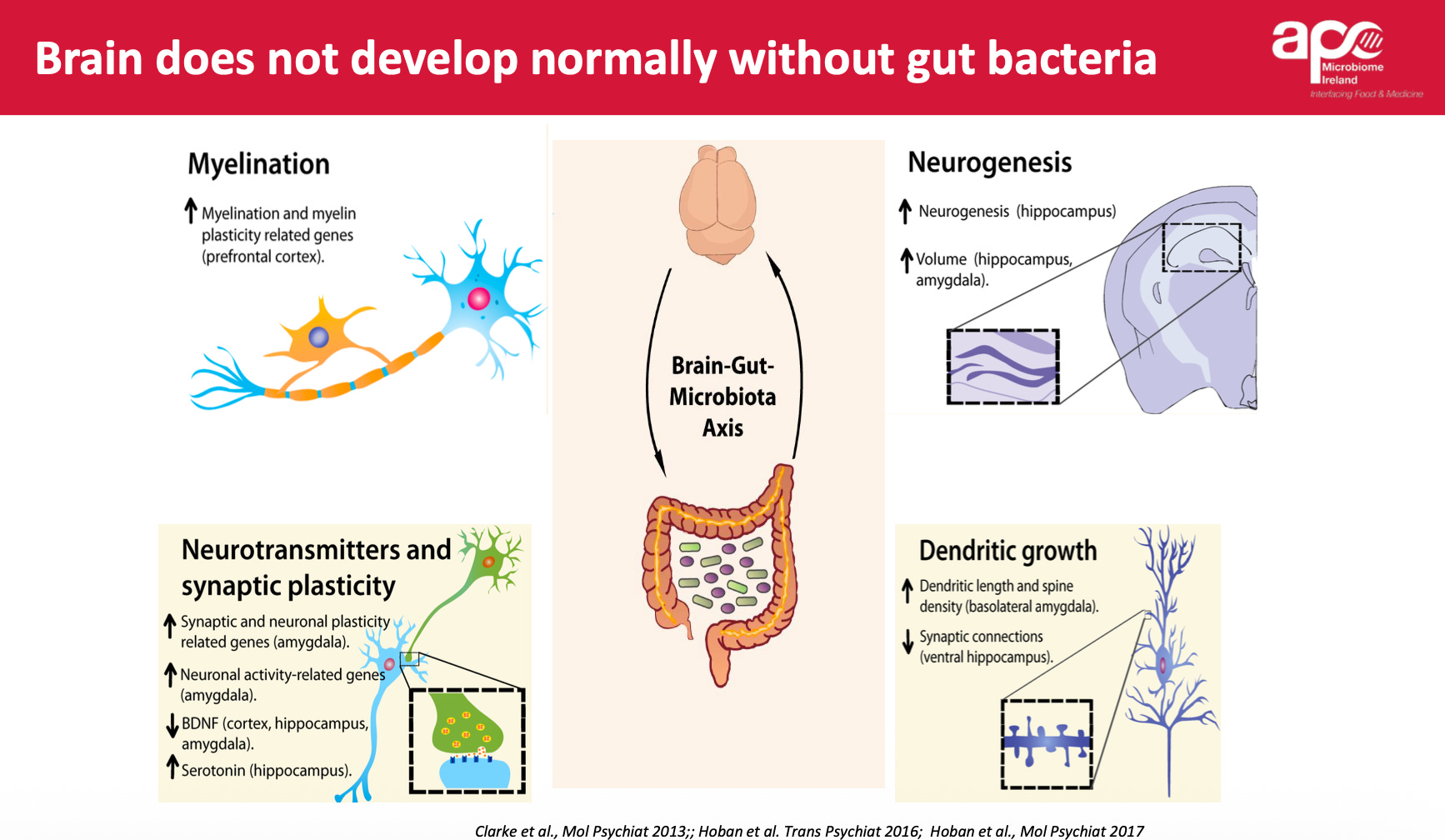
Paul showed me a paper published by APC researcher John Cryan in Cell Metabolism in early 2025, demonstrating that the gut microbiota regulates the body’s stress response in sync with its circadian rhythms³. Oscillations of gut microbes across the day, particularly Lactobacillus reuteri, directly underlie the daily rhythm of stress hormone secretion. Not over weeks or months. Daily.
The conversation between the gut and the brain is constant, bidirectional, and operating on a timescale we are only beginning to measure.
When you feel nervous before an exam and your stomach churns, that is physiology, not figure of speech. When a bad night of sleep leaves your digestion wrecked, that is the axis operating in real time.
The vast majority of the body’s serotonin is produced in the gut, not the brain⁴. The bacteria in your intestines manufacture many of the same neurotransmitters your central nervous system uses to regulate mood, motivation, and sleep: serotonin, dopamine, noradrenaline, GABA. I had known from medical school that serotonin lived in the gut, that the enteric nervous system was its own kind of brain. What I had not known, because the science did not yet exist when I trained, was that bacteria orchestrate the production. That discovery came in 2015, when Caltech researchers showed that indigenous spore-forming bacteria promote serotonin biosynthesis in enterochromaffin cells, the gut’s serotonin factories. In mice raised without those bacteria, colonic serotonin was 64 percent lower⁵.
As Paul Ross explained it, the organisms in your gut speak the same chemical language as your brain. They did not borrow it from us. We borrowed it from them. Bacteria were producing these compounds long before anything resembling a nervous system existed on the planet. When higher animals evolved and needed a neurochemical to transmit a signal from one neuron to the next, they did not invent a new molecule. They reached for the one bacteria had been making for billions of years.
Paul Ross’s colleague Noel Caplice has extended this axis in another direction. His research on what he calls the gut-heart axis has shown that systemic inflammation originating in the gut can cause structural damage to the heart. In a 2025 study published in JACC: Basic to Translational Science, his team showed in a pig model of obesity- and hypertension-related heart disease that a synbiotic, a single Lactobacillus strain paired with prebiotic fibres, reduced cardiac inflammation and improved cardiac remodelling⁶.
A bacterium residing only in the gut, treating the heart. From gut to brain, from gut to heart, the microbiome is not a local phenomenon but a switchboard.
Beyond the Human Gut
The microbiome is not only a human story. Almost every part of life, Paul Ross told me, has microbiomes associated with it. Microbes existed long before humans ever came to the planet. Almost all life is supported through the microbiomes that surround it.
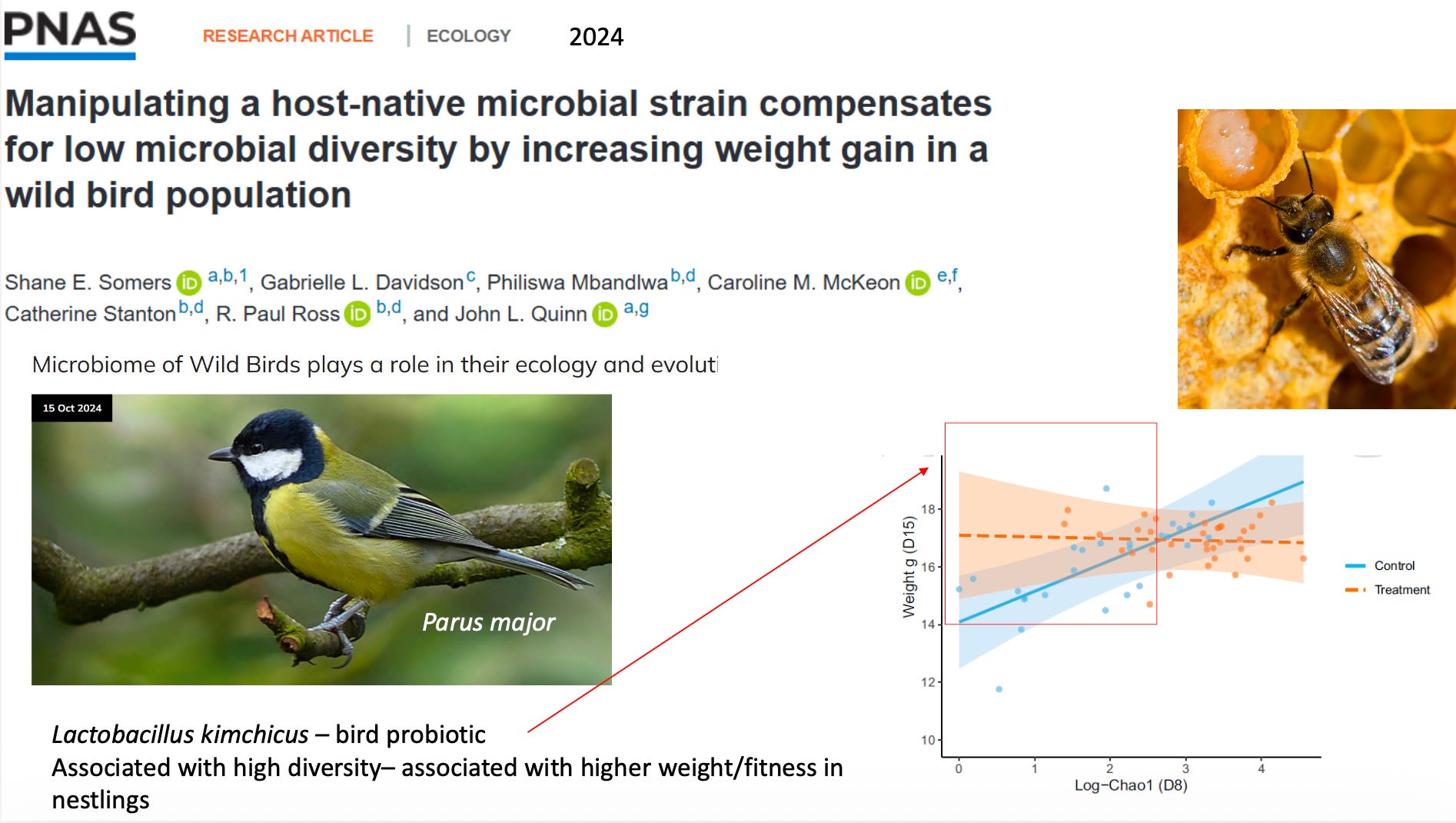
He showed me a study published in the Proceedings of the National Academy of Sciences in which his team and collaborator John Quinn’s team isolated a Lactobacillus strain directly from a wild great tit, a common Irish bird, and fed it back to nestlings as a self-administered supplement⁷. The treated birds ended up heavier, an effect strongest in the youngest nestlings, which pointed to the strain’s probiotic potential. Evidence like this, for the microbiome shaping a fitness-linked trait in the wild rather than in the laboratory, is still rare. Indeed, this is the first instance that we know of where a probiotic has an improved health effect in a wild species.
His lab, together with research collaborators Catherine Stanton and Colin Hill, is also working on bee health. Hive collapse is a global crisis with direct consequences for pollination and food security. APC researchers have isolated bacteria from the honeybee gut that produce a range of antimicrobial peptides⁸, and Paul described strains his lab has found that kill Paenibacillus larvae, a pathogen that devastates bee colonies. Methane reduction in ruminants, another microbiome problem with planetary stakes, is also on the research agenda.
It reframed the scale of what I was looking at. The APC is not just a centre for human gut health. It is a centre for understanding how microbial communities underpin the functioning of almost all living systems, from a newborn’s intestine to a beehive to a pasture.
As Paul put it: “If you try to treat things that are going wrong with us through our microbiomes, without thinking about all the inputs that go into that, you probably have an oversimplistic view of it. And you will never figure it out.”
The centre has also been a proving ground for translating discoveries into products that reach people. A probiotic strain developed at APC, Bifidobacterium longum 35624, was licensed to Procter & Gamble and sold in the United States under the brand Align⁹. My aunt in Canada has taken it for years; another aunt in Korea picked it up from her. I once spent an afternoon in the US hunting for it in stores that kept selling out. I had no idea, until that morning in Cork, that it was an APC discovery. The company that developed it, PrecisionBiotics, was acquired by Novozymes in 2020 for 80 million euros. Five spin-out companies have now emerged from the centre, with roughly the same number again in the pipeline.
The distance between a discovery in a lab and a product that changes how someone feels on a Tuesday afternoon is enormous. The APC has crossed that distance more than once. And the direction of the crossing matters. This is not industry hiring academics as consultants. It is science moving toward people because the science demands it.
The Do-Over
Paul Ross is now focused on how to positively manipulate the microbiome over time: the idea that sustained inputs can condition the microbial community toward specific functional profiles. Not a one-off intervention but a gradual reshaping, the way an athlete conditions muscle over months of consistent work. His team is investigating whether deliberate, repeated microbial exposures can shift the gut ecosystem into configurations that resist disease and support long-term immune function.
“The nice thing about the microbiome is that you can change it. The human genome, that is very difficult to change. But diet, antibiotics, exercise, all of these can change the microbiome.”
The trillions of organisms in your gut respond to what you feed them, how you move, how you sleep, who you spend time with. They are an ecosystem that tracks every choice you make. And unlike most things about the body, they offer a do-over.
I thought about my grandfather. He was doing something not so different from what Paul described: isolating organisms, feeding them, watching what conditions made them flourish. He just did not know that the same logic governed the ecosystem inside his own body. Inside mine. The natto he produced from a strain he isolated himself was a microbial intervention before anyone called it that. He was training his family’s gut at every meal without naming it.
The petri dishes on his kitchen counter and the trillions of organisms in my intestine were never separate stories. I needed 23 years of someone else’s science and a Tuesday morning in Cork to understand they were the same one.
Soul Inquiry
If the trillions of microbes in your gut could speak about the life you’ve given them so far (the foods, the stresses, the medicines, the traditions), what would they say? And what would you want them to say a year from now?”
Please share your thoughts below.
This is the first of six posts from my visit to APC Microbiome Ireland in Cork. Next: the microbiologist who built a weapon that kills one pathogen and spares a thousand neighbours, and why he says the weapon is not the point.
Many thanks to everyone at APC who so generously gave their time during my visit. The science is theirs, and I am grateful for the opportunity to share it.
References
¹ Qin, J., Li, R., Raes, J., et al. (2010). A human gut microbial gene catalogue established by metagenomic sequencing. Nature, 464, 59-65. https://doi.org/10.1038/nature08821
² Shkoporov, A. N. & Hill, C. (2019). Bacteriophages of the human gut: The “known unknown” of the microbiome. Cell Host & Microbe, 25(2), 195-209. https://doi.org/10.1016/j.chom.2019.01.017
³ Tofani, G. S. S., Leigh, S. J., Gheorghe, C. E., et al. (2025). Gut microbiota regulates stress responsivity via the circadian system. Cell Metabolism, 37(1), 138-153.e5. https://doi.org/10.1016/j.cmet.2024.10.003
⁴ Gershon, M. D. & Tack, J. (2007). The serotonin signaling system: From basic understanding to drug development for functional GI disorders. Gastroenterology, 132(1), 397-414. https://doi.org/10.1053/j.gastro.2006.11.002
⁵ Yano, J. M., Yu, K., Donaldson, G. P., et al. (2015). Indigenous bacteria from the gut microbiota regulate host serotonin biosynthesis. Cell, 161(2), 264-276. https://doi.org/10.1016/j.cell.2015.02.047
⁶ Herisson, F. M., Cluzel, G. L., Llopis-Grimalt, M. A., et al. (2025). Targeting the gut-heart axis improves cardiac remodeling in a clinical scale model of cardiometabolic syndrome. JACC: Basic to Translational Science, 10(1), 1-15. https://doi.org/10.1016/j.jacbts.2024.09.004
⁷ Somers, S. E., Davidson, G., Mbandlwa, P., et al. (2024). Manipulating a host-native microbial strain compensates for low microbial diversity by increasing weight gain in a wild bird population. Proceedings of the National Academy of Sciences. https://doi.org/10.1073/pnas.2402352121
⁸ Kamilari, E., et al. (2025). Bacillus safensis APC 4099 has broad-spectrum antimicrobial activity against both bacteria and fungi and produces several antimicrobial peptides, including the novel circular bacteriocin safencin E. Applied and Environmental Microbiology, 91(1), e01942-24. https://doi.org/10.1128/aem.01942-24
⁹ Whorwell, P. J., Altringer, L., Morel, J., et al. (2006). Efficacy of an encapsulated probiotic Bifidobacterium longumsubsp. longum 35624 (formerly B. infantis 35624) in women with irritable bowel syndrome. American Journal of Gastroenterology, 101(7), 1581-1590. https://doi.org/10.1111/j.1572-0241.2006.00734.x